Showing posts with label fun facts. Show all posts

Wednesday, September 26, 2012

10 Celebrities Who Become a Trendsetter in The World


The lives of celebrities do require them to look more attractive than others to survive in their world. No doubt if the style and make-up of celebrities has become a trendsetter or a reference value for the fans. Many artists also are a source for fashion designers and fashion trends. Here's a list of celebrities who become trendsetters dress.


  1. Lady GaGa.

 The 25-year-old singer not only danced but also cultivate smart clothing order to become the center of attention. GaGa is very obsessed with dresses often quirky and unique pros and cons among the invited artists and fashion lovers. I was so crazy about fashion GaGa's crazy about fashion even built his own private house called "Haus Of Gaga". Not only that he also reportedly memdesign nyentriknya's clothes for babies Loh!!. Draft dress GaGa was widely followed by the world renowned designer and world-famous artists.


2. Victoria Beckham


Starting from being one of the personnel girlband British "Spice Girl" made the wife's name footballer David Beckham's rise to the world's top singers. But after marrying David, Victoria keartisannya end (although not 100%) to be a good housewife. Victoria who is an icon of top socialites are often won praise from fashion critics and fashion magazines. Clothes that he was wearing a dress is always the best. For the many compliments given to him and his love of fashion, he decided to become a fashion designer. He also became well-known celebrities subscription and become a center slah trend in the world.


3. Coco Chanel


Major fashion designers homeowners adi number one in the world "Chanel" is famous throughout the world. Coco is the mother of the world's fashion world, famous blazer he was wearing at a formal party has to "God" in the world of classic fashion. Elegant classical style which he created a magnet for celebrities fashion style country. Although gone, but the style and the style he created remains a fashion trend.


4. Rihanna


This young singer is a singer who is very concerned about the less fortunate. Full name is Robyn Rihanna Fenty is known for its makeup and eccentric hairstyle. Although often criticized for having a lack of good voice but he kept flying because fashion style sexy but simple. Black singer who recently became "Women Of The Year" version of Vogue Italia had been sexually assaulted by former boyfriend Chris Brown. But despite having the problem of a dark romance songs and style of clothing is very loved by many people.


5. Beyonce '
Famous as a trio "Destiny's Child" singer Beyonce'merupakan full of amazingly talented wonderful. Although it now has a solo career, but it just did growing fame and a lot of getting pengghargaan. Having a sexy plump body, pretty face, and a nice bebusana style makes the figure of the real as an idol and tendsetter.


6. Britney Spears

The famous blonde singer beginning in the 2000s was already dressed not deny the problem. She became queen of pop a very young age and became a fashion icon at the moment. Although his name was suppressed for many cases membelitnya, but now he's back with a new buzz and fashion style has always been the icon for the fans.


7. Paris Hilton

Son of wealthy tycoons hotel chain Hilton is a socialite famous American icon. As heir to his father's wealth, makes Paris such as princess in a fairy tale that makes the ordinary girls jealous and want to be like. Skinny beautiful woman is quite independent because despite having an abundance of wealth he was willing to be an artist who has a busy schedule and he also built a network of perfume and clothing business as his own. Berbusananya style elegant and sexy dress is often a reference to the artist and modern women.


8. Katie Holmes


Famous after marrying the handsome actor Tom Cruise made the center of attention of the world. Mother of this child had been plunged in the world of acting, but did not make his name famous as now. Beautiful and elegant-looking woman is a close friend Victoria Beckham made him learn a lot about fashion and how to dress the good of his friends. This made him proficient in a matter of style of dress and an elegant look that it becomes the center of the trend of women in the world.


9. Suri Cruise


Children of the couple Katie Holmes and Tom Cruise is an only child. Although the 4-year-old, Suri has become a fashion trend because his parents had introduced the world of fashion from childhood. Suri always use J-CREW fashion label which is renowned labels for children's clothing brand. And the price of the clothes worn by Suri $ 200,000, - OMG! Sweet girl fashion style is also the reference of parents around the world to dress their children while not costing $ 200,000, -.


10. Kate Midleton


Being the wife of a British prince made this woman into the media spotlight. Berbusananya style was immediately the center of attention and a fashion icon. A simple wedding gown when he wore when marrying Prince William, has been followed by more than 10 million women who marry. Even simple everyday style that is certainly a trend setter for the women lovers a simple makeup

Source : http://terselubung.blogspot.com/2012/09/10-selebriti-yang-menjadi-trendsetter.html

Angry Birds in Real World

India-based Deviantartist Mohamedraoof took pictures of real birds and modified them to look like our feathered friends from the Angry Birds game. Check these out!


Source : http://www.geeksaresexy.net/2011/10/12/angry-birds-as-real-animals-pics/

Monday, April 11, 2011

10 Most Amazing Ghost Towns

Some abandoned ghost towns are now tourist attractions, while others might be dangerous or illegal to visit. Meet some of the most fascinating ghost towns from around the world.

1. KOLMANSKOP (Namibia): Buried in sand

Kolmanskop is a ghost town in southern Namibia, a few kilometres inland from the port of Lüderitz. In 1908, Luederitz was plunged into diamond fever and people rushed into the Namib desert hoping to make an easy fortune. Within two years, a town, complete with a casino, school, hospital and exclusive residential buildings, was established in the barren sandy desert. But shortly after the drop in diamond sales after the First World War, the beginning of the end started. During the 1950's the town was deserted and the dunes began to reclaim what was always theirs.


Soon the metal screens collapsed and the pretty gardens and tidy streets were buried under the sand. Doors and windows creaked on their hinges, cracked window panes stared sightlessly across the desert. A new ghost town had been born.


A couple of old buildings are still standing and some interiors like the theatre is still in very good condition, but the rest are crumbling ruins demolished from grandeur to ghost houses.


2. PRYPIAT (Ukraine): Chernobyl workers' home


Prypiat is an abandoned city in the "zone of alienation" in northern Ukraine. It was home to the Chernobyl Nuclear Power Plant workers, abandoned in 1986 following the Chernobyl disaster. Its population had been around 50,000 prior to the accident.


Until recently, the site was practically a museum, documenting the late Soviet era. Apartment buildings (four of which were recent constructions not yet occupied), swimming pools, hospitals and other buildings were all abandoned, and everything inside the buildings was left behind, including records, papers, TVs, children's toys, furniture, valuables, and clothing, etc. that any normal family would have with them. Residents were only allowed to take away a suitcase full of documents, books and clothes that were not contaminated. However, many of the apartment buildings were almost completely looted some time around the beginning of the 21st century.[citation needed] Nothing of value was left behind; even toilet seats were taken away. Some buildings have remained untouched. Many of the building interiors have been vandalized and ransacked over the years. Because the buildings are not maintained, the roofs leak, and in the spring the rooms are flooded with water. It is not unusual to find trees growing on roofs and even inside buildings. This hastens deterioration, and due to this, a 4-story school partially collapsed in July of 2005.


3.  SAN ZHI (Taiwan): a futuristic resort


in the North of Taiwan, this futuristic pod village was initially built as a luxury vacation retreat for the rich. However, after numerous fatal accidents during construction, production was halted. A combination of lack of money and lack of willingness meant that work was stopped permanently, and the alien like structures remain as if in remembrance of those lost. Indeed, rumors in the surrounding area suggest that the City is now haunted by the ghosts of those who died.


After this the whole thing received the cover-up treatment. And the Government, who commissioned the site in the first place was keen to distance itself from the bizarre happenings. Thanks to this, there are no named architects. The project may never be restarted thanks to the growing legend, and there would be no value in re-developing the area for other purpose. Maybe simply because destroying homes of lonely spirits is a bad thing to do. San Zhi can also be seen from an aeriel view here.


4.  CRACO (Italy): a fascinating medieval town


Craco is located in the Region of Basilicata and the Province of Matera. About 25 miles inland from the Gulf of Taranto at the instep of the “boot” of Italy. This medieval town is typical of those in the area, built up with long undulating hills all around that allow for the farming of wheat and other crops. Craco can be dated back to 1060 when the land was in the ownership of Archbishop Arnaldo, Bishop of Tricarico. This long-standing relationshop with the Church had much influence over the inhabitants throughout the ages.


In 1891, the population of Craco stood at well over 2,000 people. Though there had been many problems, with poor agricultural conditions creating desperate times. Between 1892 and 1922 over 1,300 people moved from the town to North America. Poor farming was added to by earthquakes, landslides, and War - all of which contributed to this mass migration. Between 1959 and 1972 Craco was plagued by these landslides and quakes. In 1963 the remaining 1,800 inhabitants were transferred to a nearby valley called Craco Peschiera, and the original Craco remains in a state of crumbling decay to this day.


5.  ORADOUR-SUR-GLANE (France): the horror of WWII


The small village of Oradour-sur-Glane, France, is the setting of unspeakable horror. During World War II, 642 residents were massacred by German soldiers as punishment for the French Resistance. The Germans had initially intended to target nearby Oradour-sur-Vayres and mistakenly invaded Oradour-sur-Glane on June 10th 1944. According to a survivor’s account, the men were herded into barns where they were shot in the legs so they would die more slowly. The women and children, who had been held in a church, all perished when their attempt to escape was met by machine-gun fire. The village was razed by the Germans afterward. Its ruins still stand today as a memorial to the dead and a reminder of the events that took place.


6.  GUNKANJIMA (Japan): the forbidden island


This island is one among 505 uninhabited islands in the Nagasaki Prefecture of Japan about 15 kilometers from Nagasaki itself. It is also known as "Gunkan-jima" or Battleship Island thanks to its high sea walls. It began in 1890 when a company called Mitsubishi bought the island and began a project to retrieve coal from the bottom of the sea. This attracted much attention, and in 1916 they were forced to build Japan’s first large concrete building on the island. A block of apartments that would both accommodate the seas of workers and protect them from hurricanes.


In 1959, population had swelled, and boasted a density of 835 people per hectare for the whole island (1,391 per hectare for the residential district) - one of the highest population densities ever recorded worldwide. As petroleum replaced coal in Japan in the 1960’s, coal mines began shutting down all over the country, and Hashima’s mines were no exception. In 1974 Mitsubishi officially announced the closing of the mine, and today it is empty and bare, with travel currently prohibited. The island was the location for the 2003 film ‘Battle Royale II’ and inspired the final level of popular Asian videogame "Killer7".


7. KADYKCHAN (Russia): memories of the Soviet Union


Kadykchan was one of many small Russian cities that fell into ruin when the Soviet Union collapsed. Residents were forced to move to gain access to services like running water, schools and medical care. The state moved them out over a period of two weeks, and they were taken to other towns and provided with new housing. Once a tin mining town of 12,000 people, the city is now desolate. In their hurry to leave, residents left their belongings behind in their homes, so you can now find aging toys, books, clothing and other objects throughout the empty city.


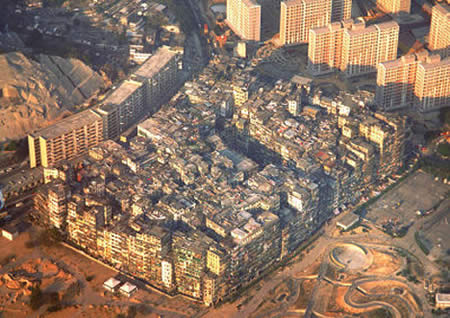
8. KOWLOON WALLED CITY (China): A lawless city


The Kowloon Walled City was located just outside Hong Kong, China during British rule. A former watchpost to protect the area against pirates, it was occupied by Japan during World War II and subsequently taken over by squatters after Japan’s surrender. Neither Britain nor China wanted responsibility for it, so it became its own lawless city.


Its population flourished for decades, with residents building labyrinthine corridors above the street level, which was clogged with trash. The buildings grew so tall that sunlight couldn’t reach the bottom levels and the entire city had to be illuminated with fluorescent lights. It was a place where brothels, casinos, opium dens, cocaine parlors, food courts serving dog meat and secret factories ran unmolested by authorities. It was finally torn down in 1993 after a mutual decision was made by British and Chinese authorities, who had finally grown wary of the unsanitary, anarchic city and its out-of-control population.


9. FAMAGUSTA (Cyprus): once a top tourist destination, now a ghost town


Varosha is a settlement in the unrecognised Republic of Northern Cyprus. Prior to the 1974 Turkish invasion of Cyprus, it was the modern tourist area of the city of Famagusta. For the last three decades, it has been left as a ghost town. In the 1970s, the city was the number one tourist destination in Cyprus. To cater to the increasing number of tourists, many new high-rise buildings and hotels were constructed.

When the Turkish Army gained control of the area during the war, they fenced it off and have since refused admittance to anyone except Turkish military and United Nations personnel. The Annan Plan had provided for the return of Varosha to Greek Cypriot control, but this never happened, as the plan was rejected by Greek Cypriot voters. As no repairs have been carried out for 34 years, all of the buildings are slowly falling apart. Nature is reclaiming the area, as metal corrodes, windows break, and plants work their roots into the walls and pavements. Sea turtles have been seen nesting on the deserted beaches.

By 2010, the Turkish Cypriot administration of the de-facto Turkish Republic of Northern Cyprus plan to reopen Varosha to tourism and the city will be populated as one of the most influential cities in the north of the island.


10. AGDAM (Azerbaijan): once a 150,000 city of people, now lost


The eerie city of Agdam, Azerbaijan was once a thriving city of 150,000 people. It was lost in 1993 during the Nagorno Karabakh war; though the city was never the setting of combat, it fell victim to vandalism while occupied by Armenians. The buildings are gutted and empty, with only the graffiti-covered mosque remaining intact. Agdam residents have moved to other areas of Azerbaijan, as well as into Iran.
source

Friday, April 1, 2011

10 Fun Facts You Didn't Know About Google


“Google is not a conventional company. We do not intend to become one.” So began the “letter from the founders” penned by Sergey Brin and Larry Page in the company’s securities registration form in 2004. Despite ever-increasing commercial success since that date, Brin and Page have kept to their word.
Google is an unconventional company with a huge stake in our online lives. It is a source of fascination for many, including us, but what really happens in the Googleplex? And what cool factoids and stats exist from the company’s relatively short past?
Here we bring you 10 fun facts about Google to quench our own thirst for Google knowledge as well as hopefully offer you a distracting diversion from your daily life.
1. The First Google Doodle
the first google doodle

Google’s famous homepage “Doodles” (the changing Google logo graphics) are well known and enjoyed by millions around the world as a way to mark an event or anniversary. But did you know that the very first Google Doodle was designed as a kind of “out of office” message?
In 1998 Brin and Page took the weekend off to go the Burning Man festival in Nevada. The Burning Man doodle (shown above), was designed by the Google guys and added to the homepage to let their users know they were out of office and couldn’t fix technical issues like a server crash.

2. Interesting Figures from the Google IPO
interesting figures from the google ipo

While the initial price for Google’s stock at its Initial Public Offering in August 2004 is an interesting stat in itself, there’s more to the story. The opening price for Google’s stock was $85 per share. At the time of writing, the stock price was $483 but has soared as high as $600 in the past year, making GOOG a rather nice investment for many.
A bonus factoid from Google’s IPO process is the value Google stated it hoped to raise on its S-1 form — as much as $2,718,281,828. It may just look like a string of numbers to non-mathletes, but 2,718,281,828 is actually the first ten digits of the mathematical constant ““e”,” showing that even as their company was planning to go public, the Google guys could still geek out with a bit of numerical humor.

3. The First Google Storage Was Made From LEGO
the first google storage
As proud hosts to Google back when it was still a research project, and known as “BackRub,” here Stanfordnow showcases the original Google storage from way back in 1996. It’s made up of a whopping 40 GB (less than a modern iPod) and it’s made from, as fans of the building bricks will be delighted to see, LEGO. It even hash funny mini-figures on the top.
Legend has it that the reason for the LEGO construction was that the Google guys needed an easily expandable, and cheap way to house 10 4 GB hard drives, and LEGO fit the bill. Whether the primary colors of the bricks used were the hues that went on to inspire the Google logo’s design is up for debate, but we’d guess it wasn’t just a coincidence.

4. Google’s First Ever Tweet
google's first ever tweet

Google’s first ever Twitter post was as satisfyingly geeky as you could hope for. The message, sent in February 2009, reads “I’m 01100110 01100101 01100101 01101100 01101001 01101110 01100111 00100000 01101100 01110101 01100011 01101011 01111001 00001010.”
For anyone not fluent in binary, here’s a hint — it’s a well known phrase from the company’s homepage. Got it? Yep, it reads: “I’m feeling lucky.”

5. Google Rents Goats
google's goats

This one isn’t actually one of Google’s infamous April Fools’ Day jokes: Google rents out goats. Yes you read that right. It rents goats from a company called California Grazing to help cut down the amount of weeds and brush at Google HQ.
The operation of 200 goats (plus herder and a border collie) is kind to the environment, and as Google puts it: “A lot cuter to watch than lawn mowers.”

6. Google’s Impact on Language
google in dictionary

While you’d think the news that the Merriam-Webster and Oxford English Dictionary adding “google” as a verb to their lexicons in 2006 would thrill the search engine, Google was actually none too pleased with the development.
“We’d like to make clear that you should please only use ‘Google’ when you’re actually referring to Google Inc. and our services,” the company wrote in a blog post at the time.
The rationale behind the semantic displeasure was that Google had “a brand to protect,” and feared Google would “slip from trademarked status into common usage.” Now, four years later, we have to say Google was fighting a losing battle — just ‘google it.’
However, we’ve found some other Google-themed linguistic delights for you — a Google staffer is commonly referred to as a “Googler,” while a new team member joins as a “Noogler.” Nooglers also used to wear a colorful hat with a spinner on top. According to a former employee, those hats are now pretty scarce in some offices, instead: “Every Noogler gets a yellow smiley balloon and a nameplate.”

7. Google Is Dog-Friendly

Google is a super dog-friendly company. It proudly names “company dogs,” like Yoshka (described as a “free-range Leonberger”) pictured above. Yoshka accompanies Urs Holzle, senior VP operations and Google Fellow to the Googleplex. Less senior staff are also allowed to bring their dogs to the office.
According to Google’s “Dog Policy”, one indiscretion too many on the Google carpets, or aggressive behavior, means Lassie will have to stay at home in the future. Strong bladdered and friendly canines are more than welcome across the campus.
Unfortunately, cats are not quite as welcome. Here’s an excerpt taken directly from Google’s Code of Conduct: “Google’s affection for our canine friends is an integral facet of our corporate culture. We like cats, but we’re a dog company, so as a general rule we feel cats visiting our offices would be fairly stressed out.”

8. Google’s First Ever “Company Snack” Was Swedish Fish
swedish fish

Back in February, 1999, the chewy candy known as “Swedish Fish” became the first ever company snack (not counting beverages) that was ordered into the Google office.
Although a relatively small event, it has led to big things. Google is infamous in the industry for treating its employees to not just free drinks and snacks on tap, but full-on gourmet meals, three times a day at a plethora of on-site cafes and eateries, as well as regular BBQs during the summer.
Brin and Page have been quoted in the past as saying no Googler should have to go more than 100 feet for food, leading to snack-filled “microkitchens” that are liberally dotted around the Google offices.
In fact, the free food is said to be so tempting that Googlers risk the “Google 15,” similar to the “Freshman 15,” where they pile on weight soon after joining the company. Good thing they also have a Google gym.
Backing this up, here’s a stat from Google — “Bay Area Googlers consumed approximately 5,500 pounds of handmade chocolates from the snack bins in the microkitchens in 2007.” Wow.

9. The Google Logo Was Not Centered Until 2001

Google’s famously sparse homepage is considered a classic design in the online world. The Google logo, however, wasn’t actually centered on the page until March 31, 2001. As early users will remember, the homepage had a bias to the left-hand side, and even earlier — back in 1998 — Google sported a Yahoo-style exclamation mark.


10. Google Has a Company Dinosaur

By all accounts, there are many wondrous sights to be seen at the Googleplex, but one of the most arresting is surely the gigantic T-Rex skeleton — nicknamed “Stan” after a “real” dino found nearby — that looms menacingly at Googlers in Mountain View.
Joining Stan in the unique campus decorations is a scale replica of the SpaceShipOne, enormous Android-themed models, pink flamingos, a large LEGO man, Google-colored phone boxes and grown-up size ball pits. One thing seems for sure — just like the company itself — life at the Googleplex must be far from dull.

LinkWithin

Related Posts Plugin for WordPress, Blogger...